Welcome to the web of Haomei Aluminum


Aluminum Coil Gauges Thickness
March 13, 2026
As a sales professional at Haomei Aluminum with years of experience in the aluminum coil export sector, gauges (thickness specifications) are a crucial communication point when interacting with global clients. Unlike the millimeter (mm) measurement commonly used in the market, the gauge system originated in North America and belongs to the Brown-Sharp measurement system. Its core characteristic is that the larger the number, the thinner the coil. Its application scenarios and market distribution have distinct regional characteristics.
Based on years of practical export experience, the most commonly used aluminum coil gauges are concentrated between 10-30, with 16, 18, 20, 22, and 24 gauges being the best-selling, covering the vast majority of civilian, industrial, and commercial applications. It is important to note that there is no fixed conversion formula between gauge and millimeter. The thickness of aluminum coils and steel coils with the same gauge can also differ. Furthermore, aluminum coils made of different alloys will have slightly different thickness deviations even with the same gauge. Haomei provides customers with a customized conversion table that accurately marks the actual thickness and deviation range for each alloy.
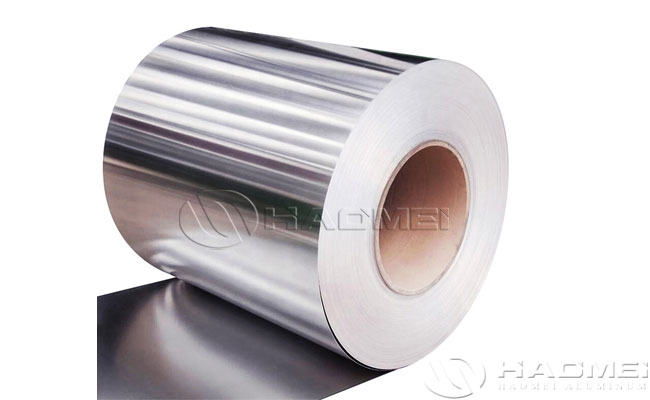
Based on practical experience, there are clear patterns in the compatibility of different gauge ranges with alloy materials: For 10-14 gauge thickness (approximately 1.2-3.51mm), 5052 and 6061 aluminum alloys are preferred due to their high tensile strength and corrosion resistance, making them suitable for heavy-duty industrial applications; for 16-22 gauge medium thickness (0.5-1.63mm), 3003 and 5052 aluminum alloys are the main choices. 3003 aluminum alloy offers excellent rust resistance, making it suitable for outdoor applications, while 5052 aluminum alloy has good formability, suitable for complex processing requirements; for 24-30 gauge thin thickness (0.2-0.51mm), 1050 and 3003 aluminum alloys are commonly used. 1050 pure aluminum has excellent ductility, suitable for food packaging and foil processing, while 3003 aluminum alloy balances ductility and toughness, making it suitable for decorative panels and lightweight casings. This is the core reason why this range is the main source of export orders.
From a market distribution perspective, countries that habitually use the gauge to express aluminum coil thickness are mainly concentrated in the imperial system and regions heavily influenced by it. The United States and Canada are core markets; our North American clients, whether construction companies or packaging enterprises, directly quote gauge values when inquiring, rarely using millimeters. The United Kingdom, Australia, and some Commonwealth countries are next; while clients in these regions occasionally mention millimeters, they prefer to use gauges as the core specification reference. In addition, some Middle Eastern clients, due to long-term cooperation with British and American companies, also use gauges. However, markets in continental Europe, China, and Japan are more accustomed to using millimeters.
Aluminum coils with different gauges are highly compatible with the application scenarios and target markets, which is the core basis for our customized solutions for clients.
24-30 gauge thin aluminum coils offer good ductility and easy forming, primarily exported to US food packaging companies for food containers and packaging foil. They can also be used for decorative panels and lightweight casings. We have a three-year long-term partnership with a California food company for our 28 gauge aluminum coils, due to their uniform thickness and corrosion resistance.
16-22 gauge medium gauges balance strength and ductility, widely used in architectural decoration, automotive parts, and HVAC ducts. These gauges are the main products exported to outdoor billboards in Australia and automotive parts manufacturers in Canada.
10-14 gauge thick gauges offer high rigidity and load-bearing capacity, primarily used for industrial equipment housings, building frames, and marine components. A UK machinery manufacturer regularly purchases our 12 gauge aluminum coils for equipment protection.
Haomei not only provides high-quality aluminum coils that meet the gauge requirements of different markets, but also accurately recommends compatible specifications based on customers’ application scenarios, avoiding losses caused by specification incompatibility and helping customers reduce procurement costs. This is the core competitiveness that has earned us the long-term trust of our customers in the global aluminum coil export market.
Maybe you like also
 Tempers of 6061 Aluminum Sheet
 6061 Aluminum Sheet Properties
 What Is 6061 T6 Aluminum Used For?
 Aluminum Coil 3105 H18 RAL 9016
 Polar White Aluminum Sheet
Copyright©2021 Haomei Aluminum Coil. All Rights Reserved. | Sitemap
 Nydia
Nydia
 Sales Manager