Welcome to the web of Haomei Aluminum


Polar White Aluminum Sheet
August 24, 2026
Among all color systems of painted aluminum sheets, white is recognized as the category with the highest quality control threshold—minor deviations in formula, furnace temperature fluctuations, and even pretreatment residues will directly manifest as yellowing, graying, or visible color differences. The ability to consistently produce white aluminum sheets with high whiteness, low color difference, and resistance to yellowing is a testament to a production line’s comprehensive management capabilities. Haomei Aluminum’s polar white aluminum sheet is a mature product that we have refined over six years to address the pain points of white sheets, with specialized technical optimizations implemented from the substrate to the coating and the entire process of quality control.
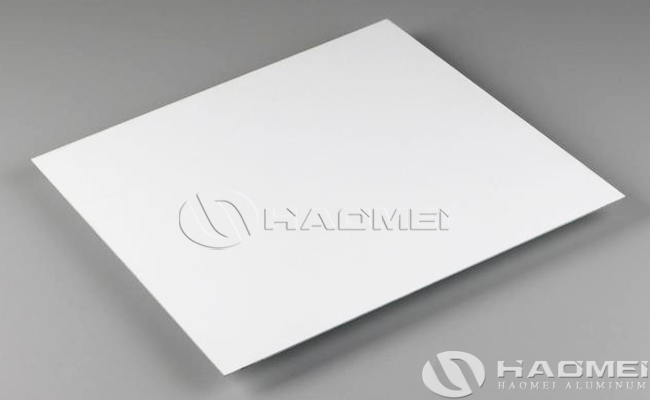
The substrate of polar white aluminum sheet covers three major series: 1060 pure aluminum and 3003/3004 aluminum-manganese alloy. The standard supply tempers are H14 and H24, with thicknesses ranging from 0.3mm to 1.5mm, effective widths from 500mm to 1700mm, and core inner diameters supporting three standard specifications: 150mm, 405mm, and 508mm. Thickness tolerance is consistently controlled within ±0.02mm, and board flatness is ≤3I, ensuring consistency in subsequent shearing, bending, and forming processes. For scenarios with higher flatness requirements, such as cleanroom projects and interior wall decoration, an additional straightening and finishing process can be added to further eliminate slight waviness on the board surface.
The core performance advantages of polar white painted aluminum sheet lie in its resistance to yellowing and color difference stability. The pigment system uses rutile titanium dioxide produced through the chloride process, combined with a weather-resistant resin carrier, avoiding the inherent defects of ordinary anatase titanium dioxide, such as easy powdering and yellowing, from the raw material end. The coating is divided into two mature systems: high weather-resistant polyester HDP dry film with a total thickness of 20-24μm, including a primer of 5-7μm, suitable for inland outdoor and indoor high-cleanliness scenarios; and PVDF fluorocarbon coating with a dry film thickness ≥25μm, matched with a special weather-resistant primer, for outdoor environments with strong ultraviolet radiation and high corrosion, such as coastal areas. After factory testing, the finished product, after 1000 hours of accelerated aging with xenon lamps, exhibits a yellowing index ΔE ≤ 2.0, exceeding the industry standard of ΔE ≤ 3.0. The batch-to-batch color difference ΔE ≤ 0.8, and the color difference between the beginning and end of the same roll ≤ 0.5, essentially eliminating visually perceptible color differences. Coating adhesion reaches level 0, with no blistering or peeling observed during a 240-hour neutral salt spray test.
From practical production experience, the most prone to quality fluctuations in white aluminum sheet materials are curing and cleanliness control. Our coating line utilizes a segmented constant-temperature curing oven with a temperature control accuracy of ±2℃. Combined with an online infrared thickness measurement and color difference detection system, data is collected every 3 meters, allowing for real-time adjustments to roller speed and oven temperature parameters. This solves the color difference problem caused by temperature differences between the beginning and end of the roll in traditional processes. Simultaneously, the coating workshop maintains a positive-pressure clean environment, reducing airborne dust on the wet film surface and significantly reducing pinholes and particle defects. This is the core reason why many overseas customers report that our polar white coating is “more evenly white and has a more delicate texture.”
The polar white aluminum sheet is currently widely used in cleanroom interior walls, food processing workshops, building exteriors and roofs, advertising signage, and refrigerated truck bodies. Based on past export project experience, for indoor applications, 1060 polar white aluminum sheet with HDP coating is the preferred choice for optimal cost-effectiveness; for outdoor construction, 3003 polar white aluminum sheet with PVDF coating is recommended, and in coastal areas with high salt spray, an epoxy anti-corrosion primer can be added. During processing, it is recommended to retain the original low-tack PE protective film, and the bending radius should be no less than 1.5 times the plate thickness to effectively prevent coating cracking and surface contamination.
With its stable performance, Haomei polar white aluminum sheets have been exported in batches to more than 30 countries, supporting numerous large-scale cleanroom projects and commercial building projects. Each batch of shipments comes with complete material certificates and coating test reports, supporting third-party re-inspection. Customers who require samples can request sample testing and verification at any time.
Maybe you like also
 Solar Reflector Aluminum Sheets
 Aluminum Circles for Spinning
 Gold Channel Letter Aluminum Coils
 Aluminum Roofing Coil Price (USD)
 Wholesale Mill Finish Aluminum Coil Factory
Copyright©2021 Haomei Aluminum Coil. All Rights Reserved. | Sitemap
 Nydia
Nydia
 Sales Manager