Welcome to the web of Haomei Aluminum


Tempers of 6061 Aluminum Sheet
September 20, 2026
6061 aluminum sheet belongs to the Al-Mg-Si series of heat-treatable, precipitation-hardened aluminum alloys. It offers a combination of medium-to-high strength, good corrosion resistance, weldability, machinability, and anodizing characteristics. Aluminum Sheet 6061 is widely used in mechanical equipment, mold base plates, automation components, marine structures, rail transportation, electronic jigs, and industrial parts for export. The performance of 6061 aluminum sheet depends largely on its “temper.” When purchasing, it is essential to confirm the alloy grade, thickness, temper, applicable standard, and dimensional tolerances.
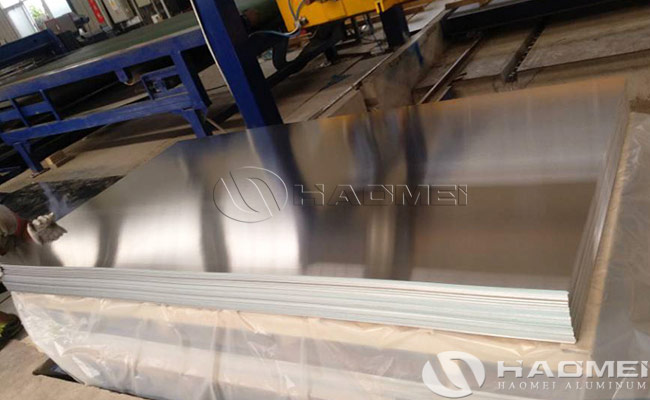
The primary alloying elements in aluminum 6061 are magnesium and silicon—typically 0.8%–1.2% Mg and 0.4%–0.8% Si—along with 0.15%–0.40% Cu and 0.04%–0.35% Cr. Various mechanical properties and processing stabilities can be achieved through processes such as solution heat treatment, quenching, natural aging, artificial aging, and stress relief.
6061-F Temper: As-Fabricated
“F” stands for “As Fabricated,” indicating the state of the material immediately after the manufacturing process, without specified work-hardening or heat-treatment protocols. Properties in this temper can vary significantly; it is typically used for semi-finished products or materials intended for further processing where strict requirements for strength, flatness, and dimensional stability are not critical.
The F temper is rarely used in precision machinery, mold making, or export orders. If the engineering drawings specify requirements for mechanical properties, hardness, or control of deformation during machining, tempers such as T6 or T651 are recommended.
6061-O Temper: Annealed
“O” denotes the fully annealed state. After annealing, the material exhibits reduced internal residual stress and improved plasticity and elongation, making it suitable for bending, deep drawing, stamping, spinning, and complex forming operations.
6061-O aluminum sheet has relatively low strength; the tensile strength is typically around 150–190 MPa, and the yield strength is approximately 55–110 MPa, with specific values depending on thickness and the applicable standard. It exhibits good surface formability but is prone to adhesion to cutting tools, burr formation, and deformation during machining. The O-temper is highly practical for parts requiring sharp-angle bending or deep drawing.
6061-T4 Temper: Solution heat-treated and naturally aged
T4 indicates that the material has undergone solution heat treatment and quenching, followed by natural aging. This temper offers good ductility and formability combined with moderate strength, making it suitable for subsequent bending, stretching, pressing, and welded structural applications.
The tensile strength of 6061-T4 is typically around 210–260 MPa, and the yield strength is approximately 110–170 MPa. Compared to T6, T4 has lower hardness and strength but carries a lower risk of cracking during bending. The T4 or T451 temper is often selected for applications such as aircraft skins, vehicle structural components, and industrial parts requiring secondary forming.
6061-T6 Temper: Solution heat treatment followed by artificial aging
T6 is the most widely used temper for 6061 aluminum sheet. After undergoing solution heat treatment, quenching, and artificial aging, the material develops fully formed precipitation-hardening phases, resulting in high strength and hardness.
Typically, 6061-T6 aluminum sheet exhibits a tensile strength exceeding 290 MPa, a yield strength exceeding 240 MPa, and a Brinell hardness of approximately 90–95 HB. Specific values may vary based on thickness, standards, and product form. The T6 temper is suitable for mechanical components, automation equipment frames, jigs, tooling plates, mold components, marine structures, and load-bearing structures.
The bending performance of the T6 temper is inferior to that of the O and T4 tempers. Factors such as bending direction, plate thickness, and inner bend radius should be evaluated prior to small-radius bending, stamping, or complex deep-drawing operations.
6061-T651 Temper: Artificial aging followed by stress-relieving stretching
T651 is a representative temper for 6061 thick aluminum plate in industrial applications. The processing sequence involves solution heat treatment and artificial aging, followed by controlled stretching to relieve residual stress. While the strength level of T651 is essentially similar to that of T6, it offers superior machining stability.
6061-T651 aluminum plate is particularly well-suited for precision CNC machining, large-surface milling, deep-cavity machining, mold base plates, jig plates, automation equipment parts, and structural components requiring high flatness. Thick plates are prone to warping during machining due to the release of internal stresses; the T651 temper significantly mitigates this risk. In industrial procurement, T651 is generally the preferred choice for machined plates exceeding 10 mm in thickness.
It should be noted, however, that T651 does not guarantee “zero deformation.” Plate deformation is also influenced by machining allowance, clamping methods, tool paths, heat dissipation during processing, and part geometry. For high-precision parts, it is recommended to employ symmetrical machining, incremental material removal, and aging stabilization processes.
Recommendations for 6061 Aluminum Sheet Temper Selection
6061-O or 6061-T4 tempers are preferred for applications requiring stamping, bending, or complex forming. 6061-T6 is widely used when moderate mechanical strength and good machinability are required. 6061-T651 offers advantages for large-format plates, precision jigs, mold base plates, or parts with deep cavities. When purchasing 6061 aluminum sheet, it is advisable to specify applicable standards—such as ASTM B209, EN 485, or GB/T 3880—and require the provision of material certificates, chemical composition reports, mechanical property reports, and ultrasonic testing documentation.
Maybe you like also
 6061 Aluminum Sheet Properties
 What Is 6061 T6 Aluminum Used For?
 Aluminum Coil 3105 H18 RAL 9016
 Polar White Aluminum Sheet
Copyright©2021 Haomei Aluminum Coil. All Rights Reserved. | Sitemap
 Nydia
Nydia
 Sales Manager