Welcome to the web of Haomei Aluminum


Cold Rolled VS Hot Rolled Aluminum Coils
November 16, 2026
Cold-rolled and hot-rolled aluminum coils represent different stages in the aluminum sheet and strip supply chain. Hot-rolled aluminum coils are produced by heating aluminum alloy ingots and rolling them; this process serves to break down the ingot structure, refine the material’s internal composition, and significantly reduce its thickness. Cold-rolled alumium coils, by contrast, are produced using hot-rolled coils or continuously cast coils as feedstock, which are then rolled further at or near room temperature to achieve thinner gauges, more precise dimensional stability, and specific material tempers.
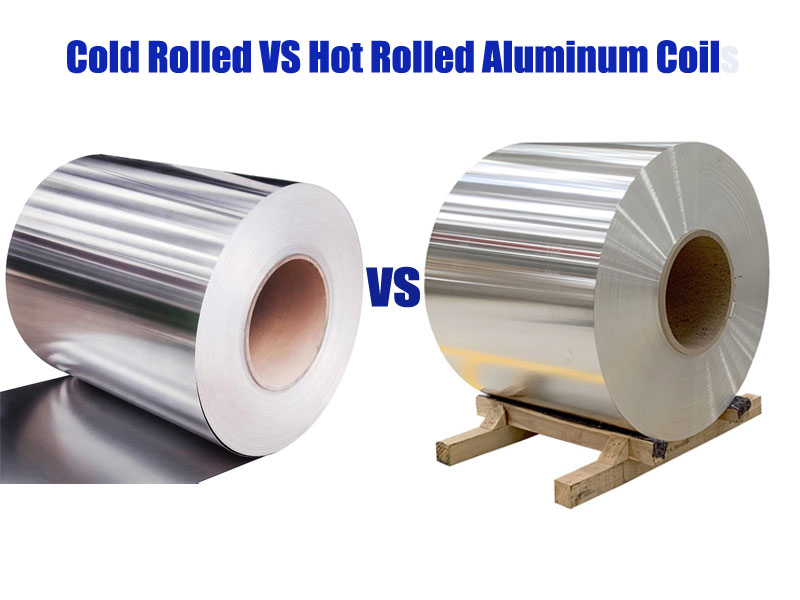
When procuring aluminum coils, the choice should be based on the intended end-use, required thickness, surface specifications, forming methods, and cost objectives—rather than relying solely on the “hot-rolled” or “cold-rolled” designation to determine material grade.
Production Process Comparison
Hot rolling typically begins with DC (Direct Chill) cast ingots. After undergoing homogenization, heating, and surface milling or sawing, the ingots pass through hot roughing and finishing mills before being coiled into hot-rolled aluminum coils. High-temperature rolling helps improve the ingot’s internal structure and quality, providing a suitable feedstock for subsequent cold rolling, the production of thick plates, or further deep processing.
Cold rolling utilizes hot-rolled coils, continuously cast coils, or other specific intermediate blanks, which are reduced in thickness through multiple rolling passes. As the material undergoes greater reduction, it experiences work hardening; consequently, intermediate or final annealing may be required. Further finishing processes—such as tension leveling, edge trimming, slitting, cut-to-length, protective film application, coating, or embossing—can also be performed.
Thickness and Dimensional Precision
Hot-rolled aluminum coils typically have a thickness ranging from approximately 2.0 to 8.0 mm. Depending on equipment capabilities, some products can be produced in greater thicknesses or serve as feedstock for further gauge reduction via cold rolling. Thickness tolerances and surface quality grades are generally determined based on the requirements for intermediate processing or medium-to-heavy plate applications.
Cold-rolled aluminum coils typically range from approximately 0.20 to 6.0 mm in thickness and can be further processed into thinner stock for foil rolling. Cold-rolled products generally offer superior thickness control, better flatness, and a smoother surface, making them well-suited for high-precision slitting, stamping, roll forming, coil coating, and lamination.
Specific thickness ranges and tolerances should be confirmed based on the alloy, width, temper, applicable technical standards, and the technical agreement between the supplier and the purchaser.
Surface and Mechanical Properties
Hot-rolled aluminum coils may retain some mill scale, roll marks, or surface roughness; they typically require subsequent processing—such as pickling, cold rolling, brushing, or other finishing operations—to meet the requirements for high-quality surface grades. Common tempers for these products include H111, H112, or various intermediate process tempers.
Cold-rolled aluminum coils generally feature a finer surface finish, making them suitable for applications such as painting, film lamination, anodizing, mirror-finishing, and precision stamping. By controlling work hardening and annealing processes, the material can be supplied in various tempers—such as O, H12, H14, H16, H18, H24, and H32—to achieve the desired balance between strength and formability.
The distinction between hot rolling and cold rolling does not, in itself, solely determine the final strength of the material. Instead, the tensile strength, yield strength, and elongation are collectively influenced by the alloy grade, temper, annealing regimen, thickness, and any subsequent heat treatment.
Differences in Common Applications
| Comparison | Hot-Rolled Aluminum Coils | Cold-Rolled Aluminum Coils |
| Typical Thickness | Approx. 2.0–8.0 mm | Approx. 0.20–6.0 mm |
| Surface Quality | Industrial/intermediate finish or plate-like surface | Smoother, suitable for finishing and surface treatments |
| Dimensional Accuracy | Standard | Generally higher |
| Common Uses | Cold-rolled blanks, heavy-gauge processing, tank bodies, and structural components | Color coating, stamping, construction, home appliances, aluminum discs, and slit strips |
| Common Tempers | H111, H112, and intermediate tempers | O, H-series, and specific stabilized tempers |
How to Choose?
If your project requires heavy gauges, a hot-rolled metallurgical structure, feedstock for further cold rolling, or structural materials, consider hot-rolled aluminum coils. If you require thin gauges, precise thickness control, a high-quality surface, suitability for coating, or complex forming capabilities, cold-rolled aluminum coils are a better choice.
When requesting a quote, please specify the alloy, temper, thickness, width, core size, coil weight, surface requirements, intended downstream processing, and applicable standards. Haomei Aluminum supplies 1xxx, 3xxx, 5xxx, 6xxx, and 8xxx series hot-rolled and cold-rolled aluminum coils. We also offer services such as slitting, cut-to-length, protective film application, color coating, and export-ready packaging.
Maybe you like also
 What Are Cold-Rolled Aluminum Coils?
 What Is Hot Rolled Aluminum Coil?
 1050 H16 Aluminum Sheet
 1050 H14 Aluminum Sheet
Copyright©2021 Haomei Aluminum Coil. All Rights Reserved. | Sitemap
 Nydia

 Sales Manager